Air Conditioner Installation Cost (2026): Window, Central & Mini-Split Prices
AC installation costs $400–$800 for a window unit, $3,500–$8,000 for central air, and $2,000–$6,000 for a mini-split. 2026 ranges and what drives the quote.
Which option fits your situation?
| If this describes you | Choose | Typical cost | Why |
|---|---|---|---|
| One room needs cooling | Window or mini-split unit | $500–$3,000 | Conditioning the whole house for one room is the most common overspend here. |
| Whole house, existing ductwork is sound | Central AC, reuse ducts | $3,000–$6,500 | Reusing ductwork is the largest available saving on a central install. |
| Whole house, ductwork is failing | Budget for new ducts too | add $2,500–$8,000 | This is the item most quotes leave out, and it is the one that moves the total the most. |
| House has no ductwork and no attic space | Ductless mini-split system | per-zone pricing | Avoids the entire ducting cost. Best where ducts genuinely cannot be run. |
| You are replacing in a heatwave | Wait for the shoulder season if you can | Often lower | Spring and autumn installs are easier to book and quoted lower than emergency summer rates. |
Typical cost ranges
| Item | Low | High | Notes |
|---|---|---|---|
| Window AC unit — DIY install | $150 | $600 | Equipment only; you install it. No labor. |
| Window AC — professional install | $400 | $800 | Includes bracket/support and sealing. |
| Central AC installation (full system) | $3,500 | $8,000 | Includes condenser, coil, and line set. |
| Central AC — replacing existing | $3,000 | $6,500 | Cheaper when ductwork is reused. |
| Ductless mini-split — single zone | $2,000 | $4,500 | One indoor head; pro install strongly advised. |
| Mini-split — multi-zone (per zone) | $1,500 | $3,000 | Each additional head adds cost. |
Ranges are typical U.S. market estimates for 2026 and vary by region, home, and contractor. Always confirm a written quote before work begins.
What the quote often misses
These are the items that most often sit outside the headline price. They are not always needed, but when they are required they are what turns a mid-range quote into a top-of-range one.
| Item | Low | High | Why it is often missed |
|---|---|---|---|
| New ductwork (if needed) | $2,500 | $8,000 | Quotes usually assume existing ductwork is sound. If it is undersized or leaking, this is the largest single addition. |
Installation cost depends almost entirely on which type of system you choose, not on brand. A window unit you install yourself costs $150–$600 for the equipment alone. Central air runs $3,500–$8,000 installed. A single-zone mini-split sits in between at $2,000–$4,500.
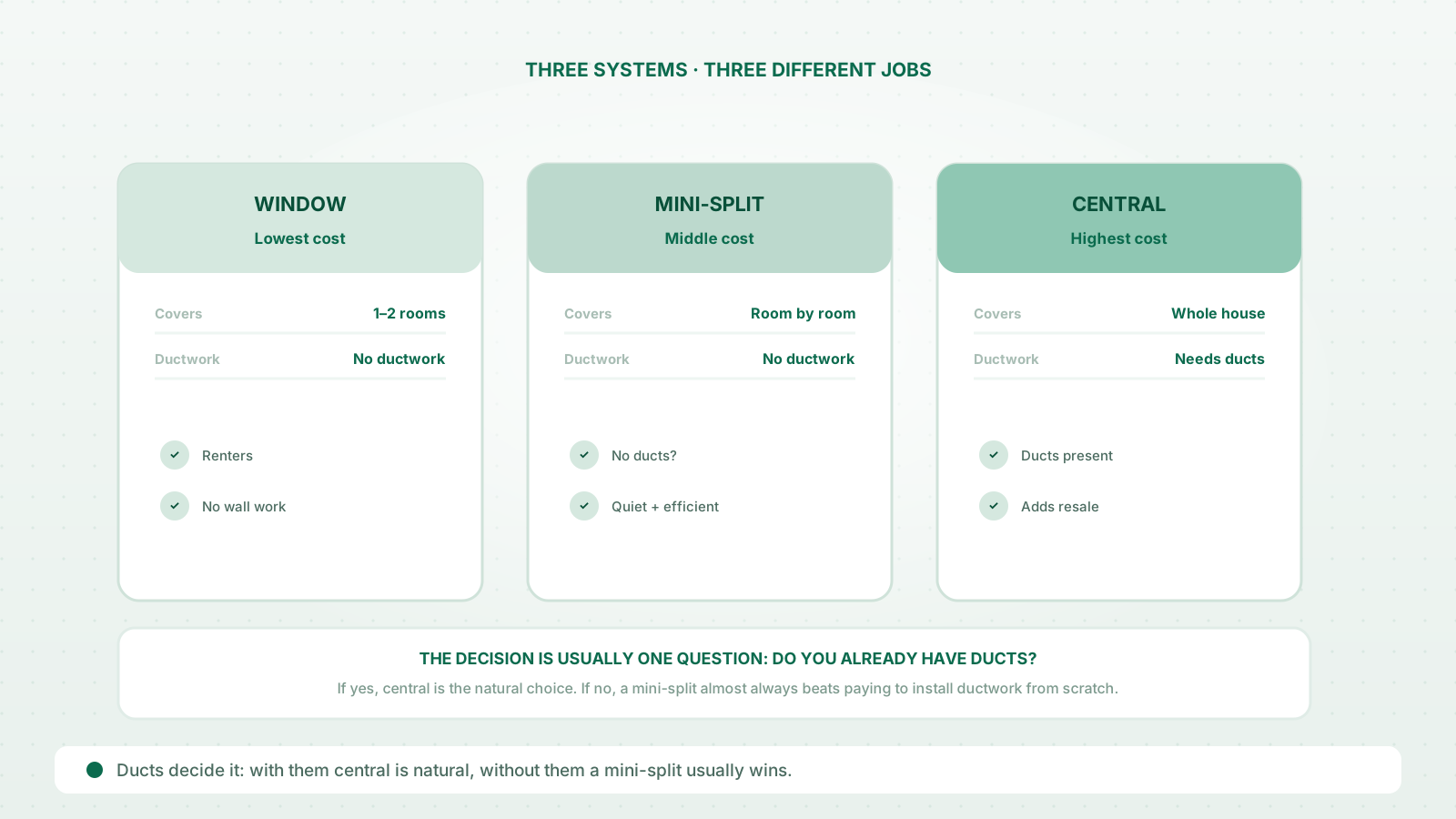
The three routes, compared
| System | Installed cost | Best for | DIY? |
|---|---|---|---|
| Window unit | $400–$800 (or equipment-only $150–$600) | One room | ✅ Yes |
| Mini-split | $2,000–$4,500 (single zone) | One to three rooms, no ducts | ⚠️ Pro advised |
| Central air | $3,500–$8,000 | Whole house | ❌ No |
What actually drives the price
1. Refrigerant and electrical work. Central systems and mini-splits need refrigerant lines and dedicated electrical circuits. This licensed work is the single biggest cost and cannot be done legally by an unlicensed homeowner in most states.
2. Ductwork. Central air assumes ducts exist. If your home has none, adding ductwork can cost $2,500–$8,000 on top — which is often when a mini-split becomes the better value.
3. System size (tonnage). A larger home needs a larger system. Sizing should follow a load calculation, not a guess; an oversized unit costs more and cools less efficiently.
4. Efficiency tier. Higher-SEER2 units cost more upfront but cut running costs. The break-even depends on your electricity rate and how many months you run the system.
Where the money goes
For a central install, equipment is typically only 40–50% of the quote. The rest is labor, electrical, refrigerant, permits, and disposal of the old unit. That is why two quotes for the “same” system can differ by thousands — always compare the scope, not just the equipment model.
How to save without cutting corners
- Right-size the system. A proper load calculation prevents paying for capacity you cannot use. Oversizing also hurts efficiency and dehumidification.
- Reuse existing ductwork when replacing central air — it is the largest available saving, provided the ducts are sound and correctly sized.
- Cool one room with a window or mini-split unit instead of conditioning the whole house, if that is genuinely all you need.
- Schedule in the shoulder season. Spring and autumn installs are easier to book and often quoted lower than the July emergency rate.
- Take the utility rebate. Many utilities pay $300–$1,000 for a high-efficiency unit. Ask before you buy, not after — some rebates require specific models.
- Get three quotes on identical specifications. Comparing different equipment is not a comparison. Write the spec down and hand the same sheet to each contractor.
Common upsells
- “You need a bigger system” without a load calculation. Ask to see the numbers.
- Extended warranties on top of manufacturer coverage.
- Unnecessary duct cleaning or sealing bundled into the install.
Bottom line
If you need to cool one room, a window unit you install yourself is by far the cheapest option. If you need whole-house cooling and already have ducts, central air is the standard route at $3,500–$8,000. If you have no ducts or want room-by-room control, a mini-split is the middle path. In every case, the quote’s labor and scope matter more than the brand on the box.
Window, mini-split, or central: how to actually choose
The three systems are not really competitors — they solve different problems. The table is the fast version of the decision; the detail follows below it.
| Your situation | Window unit | Mini-split | Central air |
|---|---|---|---|
| Rooms to cool | One or two | One, or room by room | Whole house |
| Existing ductwork | Not needed | Not needed | Required |
| You rent, or cannot modify the home | ✅ Best fit | ◐ Needs wall access | ❌ Not viable |
| Upfront cost | Lowest | Middle | Highest |
| Running cost | Highest per room | Low | Lowest per room |
| Noise inside | Noticeable | Very quiet | Quiet |
| Adds resale value | Little | Some | Yes |
| Avoid if | You need more than two rooms cooled | You already have sound ductwork — central is cheaper to run | You have no ducts and no room to run them |
Choose a window unit if:
- You need to cool one or two rooms and nothing more.
- You rent, or you cannot modify the home.
- You want the lowest possible upfront and installation cost.
- The room has a suitable window and you can lift the unit safely.
Choose a mini-split if:
- Your home has no ductwork and adding it is impractical or too expensive.
- You want room-by-room control — cool the bedroom without cooling the whole house.
- You want a quieter, more efficient system than a window unit without a full central install.
- You are renovating and can plan the wall penetration ahead of time.
Choose central air if:
- Your home already has ductwork.
- You need to cool the whole house evenly.
- You want a single thermostat and a system that adds resale value.
- The upfront cost fits your budget and you plan to stay long enough to benefit.
The decision usually comes down to one question: do you already have ducts? If yes, central air is the natural choice. If no, a mini-split almost always beats paying to install ductwork from scratch.
The honest case against all three: if you need cooling in one room for a few weeks a year, a portable or window unit beats every option above on cost. The larger systems only pay back when you are cooling most of the house through most of the summer.
What drives the price, in order of impact
1. The type of system — the single biggest factor. A window unit is hundreds; central air is thousands.
2. Ductwork — if your home has none, adding it costs $2,500–$8,000 on top of everything else. This is often what tips the decision toward a mini-split.
3. Electrical work — central systems and larger mini-splits need dedicated circuits, sometimes a panel upgrade. Licensed electrical work is a major line item.
4. Refrigerant lines — central and mini-split systems need refrigerant lines run and charged by a licensed technician. This work is not a DIY task in most jurisdictions.
5. System size (tonnage) — a bigger home needs a bigger system. Sizing should follow a load calculation, not a rule of thumb.
6. Efficiency tier (SEER2) — higher efficiency costs more upfront but lowers running costs. The break-even depends on your electricity rate and climate.
A realistic budget picture
Scenario: cooling a single 300-square-foot room.
- Window unit, DIY: $150–$600 for the equipment, installed in an hour. This is the cheapest option, full stop.
- Window unit, professional: $400–$800 installed.
- Single-zone mini-split: $2,000–$4,500 installed. Quieter and more efficient, but a much bigger spend for one room.
Scenario: cooling a whole 1,800-square-foot house with existing ducts.
- Central air replacement: $3,000–$6,500 installed, since ductwork already exists.
- New central air (with ducts): $3,500–$8,000+.
- Multi-zone mini-split: four zones at $1,500–$3,000 each = $6,000–$12,000, usually more than central air for whole-house coverage.
That last comparison is the important one: mini-splits win for one or two rooms, but central air is generally more economical for cooling an entire house.
Where the money actually goes
For a central AC install, the equipment is often only 40–50% of the quote. The rest is labor, electrical, refrigerant, permits, and disposal of the old unit.
This is why two quotes for the “same” system can differ by thousands of dollars. They are rarely quoting the same scope. Always compare the written scope — equipment model, line set, electrical work, permits, and disposal — not just the headline number.
Questions to ask before you sign
- Is the system sized by a load calculation? Ask to see the numbers; a guess is a red flag.
- What SEER2 rating, and does it qualify for rebates?
- Is the permit included, or is that on you?
- What is the warranty on parts and on labor, separately?
- Will you remove and dispose of the old unit?
- Is the line set and refrigerant charge included?
A contractor who answers these clearly and in writing is a safer bet than one who quotes fastest.
Common upsells to watch out for
- “You need a bigger system” without a documented load calculation.
- Extended warranties layered on top of manufacturer coverage.
- Bundled duct cleaning or sealing you did not ask for.
- Peak-season urgency pricing that disappears if you wait a week.
FAQ
How long does installation take? A window unit takes under an hour. A mini-split is usually a one-day job. Central air is typically one to three days, longer if new ductwork or electrical work is required.
Can I install a mini-split myself? The indoor and outdoor units can be physically mounted, but the refrigerant lines must be run and charged by a licensed technician. Most manufacturers require professional installation to keep the warranty valid.
Is a window unit worth it versus a portable AC? For a single room, a window unit is generally more efficient and cheaper to run than a portable unit of similar capacity, though a portable unit is easier to place where a window is unsuitable.
How often should an AC be serviced? Once a year, ideally before the cooling season. Annual maintenance costs far less than a mid-summer breakdown.
Recommended equipment
How we arrived at these figures
Figures reflect published equipment prices, contractor installation quotes and typical permit costs gathered from several U.S. markets for a single-family home.
The installed range is broad because equipment tier and ductwork condition dominate it. Two homes of identical size can differ by thousands based on whether existing ductwork can be reused.
- These are ranges, not quotes. Real prices vary by region, season, property condition and access. Always get a written quote before committing to work.
- We are independent.
Some links on this page are affiliate links, marked
rel="sponsored". They do not change what we recommend, and we recommend against buying in some situations. - Where we are unsure, we say so. If a figure rests on a small sample or a single source, we say that rather than rounding it into false precision.
Frequently asked questions
How much does it cost to install central air conditioning?
A full central AC installation typically runs $3,500–$8,000, including the outdoor condenser, indoor coil, and line set. Replacing an existing system is usually cheaper ($3,000–$6,500) because the ductwork is already in place.
Can I install a window air conditioner myself?
Yes. A window unit is designed for DIY installation and needs only a secure bracket, a level fit, and proper sealing around the edges. This saves the entire labor cost, which is why window AC is the cheapest route to cool a single room.
Is a mini-split cheaper to install than central air?
For a single room, yes. A one-zone mini-split usually costs $2,000–$4,500 installed, versus $3,500–$8,000 for central air. Mini-splits get more expensive as you add zones, so central air can be more economical for cooling a whole house.
Why is AC installation so expensive?
The cost is mostly labor, electrical work, refrigerant handling, and permits — not the equipment. Central systems require licensed technicians for refrigerant lines and electrical connections, which is the largest line item in the quote.
How long does AC installation take?
A window unit takes under an hour. A mini-split is usually a one-day job. A full central air installation typically takes one to three days depending on whether new ductwork or electrical work is required.