Air Conditioner Repair Cost (2026): What Each Fix Should Cost
AC repair costs $150–$650 on average. See what each common fix should cost, how to tell repair from replace, and what a fair quote looks like in 2026.
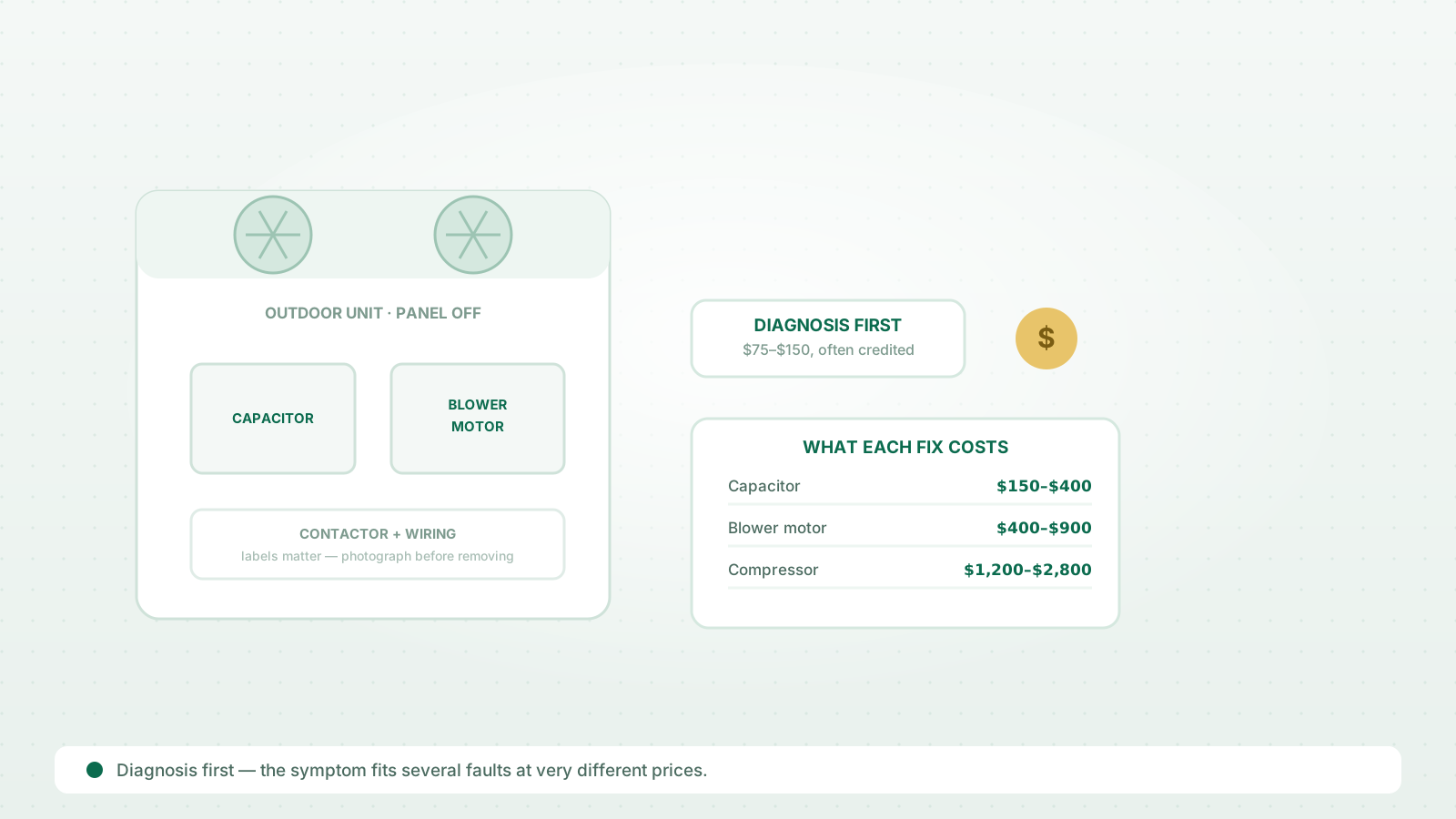
Which option fits your situation?
| If this describes you | Choose | Typical cost | Why |
|---|---|---|---|
| AC not cooling, but running | Diagnose before repairing | $75–$150 diagnostic | The symptom points to several faults at very different prices. A diagnosis prevents paying replacement money for a $200 capacitor. |
| Unit is 15+ years old and needs a major part | Replace, not repair | Repair $1,200+ vs replace $4,000+ | Spending major money on an end-of-life system rarely pays back. The page’s "repair or replace" test covers the exception. |
| Repair under $500 on a system under 10 years | Repair | $150–$500 | Still inside its useful life, so the repair is the cheaper route by a wide margin. |
| Refrigerant has leaked more than once | Find and seal the leak first | $300–$1,500 | A recharge without a sealed leak is a recurring cost, not a repair. This is the most common way to waste money on an AC. |
| You have been quoted a price with no written diagnosis | Get the diagnosis in writing | $0 | A written diagnosis is what makes a second opinion possible. Ask before approving any major work. |
Typical cost ranges
| Item | Low | High | Notes |
|---|---|---|---|
| Diagnostic / service call | $75 | $150 | Often waived if you approve the repair. |
| Refrigerant recharge (R-410A) | $150 | $600 | A leak means you will pay this again unless it is fixed. |
| Capacitor replacement | $150 | $400 | Common cause of a unit that won't start. |
| Blower motor replacement | $300 | $700 | Weak or no airflow is the usual symptom. |
| Condenser fan motor | $250 | $600 | Outdoor unit runs but does not cool. |
| Compressor replacement | $800 | $2,000 | Often the point where replacement wins. |
| Thermostat replacement | $100 | $400 | Includes the unit and labor. |
| Drain line clog / condensate fix | $100 | $250 | Water leaking near the indoor unit. |
| Electrical / control board | $300 | $900 | Varies with part availability. |
Ranges are typical U.S. market estimates for 2026 and vary by region, home, and contractor. Always confirm a written quote before work begins.
Most AC repairs cost $150–$650, but that range hides a huge spread. A thermostat swap and a compressor replacement are both “AC repair” and they differ by more than ten times in price. Knowing the typical cost of each fault is how you tell a fair quote from an inflated one.
Cost by repair type
| Repair | Typical cost | Usual symptom |
|---|---|---|
| Diagnostic service call | $75–$150 | You don’t know what’s wrong yet |
| Capacitor replacement | $150–$400 | Unit hums but won’t start |
| Thermostat replacement | $100–$400 | No response, wrong readings |
| Drain line clog | $100–$250 | Water pooling near indoor unit |
| Condenser fan motor | $250–$600 | Outdoor unit runs, no cooling |
| Blower motor | $300–$700 | Weak or no airflow indoors |
| Refrigerant recharge | $150–$600 | Cooling but not cold enough |
| Electrical / control board | $300–$900 | Erratic or no operation |
| Compressor | $800–$2,000 | No cooling at all |
Notice the pattern: parts are rarely the expensive part. Labor and refrigerant are. That is why a $30 capacitor costs $150–$400 installed.
What each symptom usually means
No cooling at all, outdoor unit silent. Often a capacitor, a tripped breaker, or a control board. Start cheap — check the breaker first.
Outdoor unit runs, but the air is warm. Usually low refrigerant or a failed compressor. Ask for a leak test before anyone just “tops it off.”
Weak airflow indoors. A clogged filter, a failing blower motor, or a blocked evaporator coil. Change the filter before calling anyone.
Water near the indoor unit. A clogged condensate drain. This is a cheap fix if caught early and an expensive one if water damages the ceiling.
Unit short-cycles. Often an oversized system, a thermostat fault, or a refrigerant issue.
Repair or replace? The honest test
Use three questions:
- How old is the system? Over 10–15 years, lean toward replacement.
- How big is the repair relative to a new unit? A common guideline is roughly one-third of replacement cost. Above that, replace.
- Is it a major component? Compressor, coil, or a repeated refrigerant leak all push toward replacement.
If you answer “old, expensive, and a major part,” the money is better spent on a new, more efficient system — which also cuts your summer electricity bill.
How to avoid being overcharged
- Get the diagnosis in writing, including the part and the labor separately.
- Ask for a leak test if refrigerant is involved. A recharge without fixing the leak is a repeat bill.
- Get two or three quotes for anything over a few hundred dollars. Prices vary widely by region and company.
- Ask whether the service-call fee is waived if you approve the repair — many companies do this.
- Be wary of “you need a whole new system” delivered without a written diagnosis. Ask what specifically failed.
Preventing the expensive repairs
The cheapest repair is the one you never need:
- Change the filter every 1–3 months. This is the single biggest cause of avoidable AC problems.
- Get annual service before each cooling season. Typical cost is $100–$200 and it catches failing capacitors and low refrigerant early.
- Keep the outdoor unit clear of leaves, dirt, and obstructions.
- Fix drain clogs early before they cause water damage.
FAQ
How much is a service call just to diagnose? Usually $75–$150, often credited toward the repair if you approve it.
Can I replace a capacitor myself? Physically yes, but capacitors store a dangerous charge and the diagnosis matters. For most homeowners, having a technician do it is safer and not much more expensive.
Should I repair a 20-year-old AC? Almost always no — beyond routine wear parts, spending serious money on a system at the end of its life rarely pays back. Put that money toward a newer, more efficient replacement.
Is a yearly service plan worth it? Usually yes. At $100–$200 a year, a plan that catches a failing capacitor or low refrigerant before it becomes a summer breakdown pays for itself. It also often gets you priority scheduling.
How long should a repair last? A capacitor or contactor replacement should last several years. A refrigerant leak repair depends on whether the leak was found and sealed properly — a recharge alone may not hold. Ask what was fixed, not just what was refilled.
Do I need to be home for the repair? Yes for anything that involves entering the house or testing the air handler. Outdoor condenser-only work can sometimes be done without you present, but you will want the written diagnosis explained either way.
How to read an AC repair quote
A fair quote has four parts. If any is missing, ask for it before you approve the work.
- The diagnosis — what specifically failed, in plain language.
- The part — manufacturer, part number, and whether it is OEM or aftermarket.
- Labor — the hours and the rate, or a flat fee.
- The warranty on the repair — parts and labor, and how long each lasts.
A quote that says only “AC repair: $850” tells you nothing. You cannot tell whether that is a capacitor (should be $150–$400) or a compressor (which may justify replacement).
Warranty: what you should get
- Parts warranty — typically the manufacturer covers the part for a period (often 5–10 years on major components for registered systems).
- Labor warranty — usually much shorter, often 30–90 days on the repair itself.
- Registration — some manufacturers require the system to be registered to honor the full parts warranty. Ask whether your system is registered.
If a repair fails within the labor warranty window, the repair should be redone at little or no cost. Get this in writing — verbal promises are worth nothing a month later.
When to get a second opinion
Get another quote when:
- The diagnosis is a major component (compressor, coil) — these are expensive enough to justify a second visit.
- The recommendation is a full system replacement without a documented diagnosis.
- The quote is more than double a typical range for the stated fault.
- The technician cannot explain what failed in plain language.
A diagnostic fee of $75–$150 is cheap insurance against a $2,000 mistake. Many companies waive it if you proceed with the repair.
Emergency vs. scheduled service
| Scheduled (spring/fall) | Emergency (peak summer) | |
|---|---|---|
| Response time | Days | Hours |
| Labor rate | Standard | Often higher |
| Parts availability | Better | Sometimes delayed |
| Pressure to decide | Low | High |
Scheduling maintenance before the cooling season is both cheaper and safer. During a mid-summer breakdown, you are in a weak negotiating position — which is exactly when the largest unneeded repairs get sold.
Maintenance that prevents repairs
The repairs on this page are the ones that recur when maintenance is skipped:
- Filters every 1–3 months. Dusty filters overwork the blower and freeze coils.
- Annual professional service ($100–$200). Catches weak capacitors, low refrigerant, and dirty coils before they fail.
- Keep the outdoor unit clear. Trim vegetation and clear debris so the condenser can reject heat.
- Fix small water leaks early. A clogged drain line is a $100–$250 fix, or a several-thousand-dollar ceiling repair if ignored.
- Do not run the system with a known problem. Continuing to run a unit with a failing compressor or frozen coil turns a cheap fix into an expensive one.
How to know if a technician is being straight with you
- They show you the failed part or the reading (capacitor microfarads, refrigerant pressures).
- They explain the options — repair versus replace — with numbers, not pressure.
- They do not upsell a “tune-up package” you did not ask for while quoting an emergency.
- They are willing to put the diagnosis in writing.
Most HVAC technicians are honest. The industry’s reputation problem comes from a minority who sell capacity and replacements homeowners do not need. A written diagnosis and a second quote on major work neutralize that risk entirely.
Recommended equipment
How we arrived at these figures
Figures reflect published HVAC service rates and contractor price lists from multiple U.S. markets, grouped by the repair a technician would actually quote.
Repair prices cluster by part rather than by brand. The spread within a single repair type comes from refrigerant handling, access difficulty and whether the call is scheduled or an emergency.
- These are ranges, not quotes. Real prices vary by region, season, property condition and access. Always get a written quote before committing to work.
- We are independent.
Some links on this page are affiliate links, marked
rel="sponsored". They do not change what we recommend, and we recommend against buying in some situations. - Where we are unsure, we say so. If a figure rests on a small sample or a single source, we say that rather than rounding it into false precision.
Frequently asked questions
How much does AC repair cost on average?
Most single-fault AC repairs run $150–$650, including the service call. Capacitors, fan motors, and thermostat faults sit at the low end; compressor replacement and refrigerant leaks push toward the top, and often make replacement the better value.
Should I repair or replace my AC?
A common rule is to consider replacement when the repair costs more than about a third of a new system, when the unit is over 10–15 years old, or when the repair is to a major component like the compressor. If a refrigerant leak keeps returning, replacement is almost always the better long-term decision.
Why is AC repair so expensive?
Most of the cost is labor and refrigerant, not parts. Refrigerant must be handled by a licensed technician, diagnostics take time, and parts for older systems can be scarce. The labor rate, not the capacitor, is what you are mostly paying for.
Is it cheaper to repair or replace a 15-year-old AC?
Usually replace. A 15-year-old system is near the end of its life, uses older refrigerant, and is less efficient. Spending a large repair bill on it rarely pays back, whereas a new higher-efficiency system cuts running costs for years.
What causes most AC failures?
The most common faults are a failed capacitor, dirty filters or coils causing the unit to overheat, refrigerant leaks, and electrical or control-board failures. Regular filter changes and annual service prevent many of them.